01
Reliability
A payment is final when we say it's final, not a moment before. It moves through Pending → Safe → Finalized and holds through reorgs, then settles into balances that don't lie.
PendingSafeFinalized
Suward is a stablecoin payment gateway for EVM merchants. The job is simple to say and hard to do: take a payment in crypto and prove it really arrived. Every payment gets its own deposit address. From there it runs through Pending → Safe → Finalized and settles into a balance you can read. The fee is 0.4% + min $1, with nothing hidden in the spread.
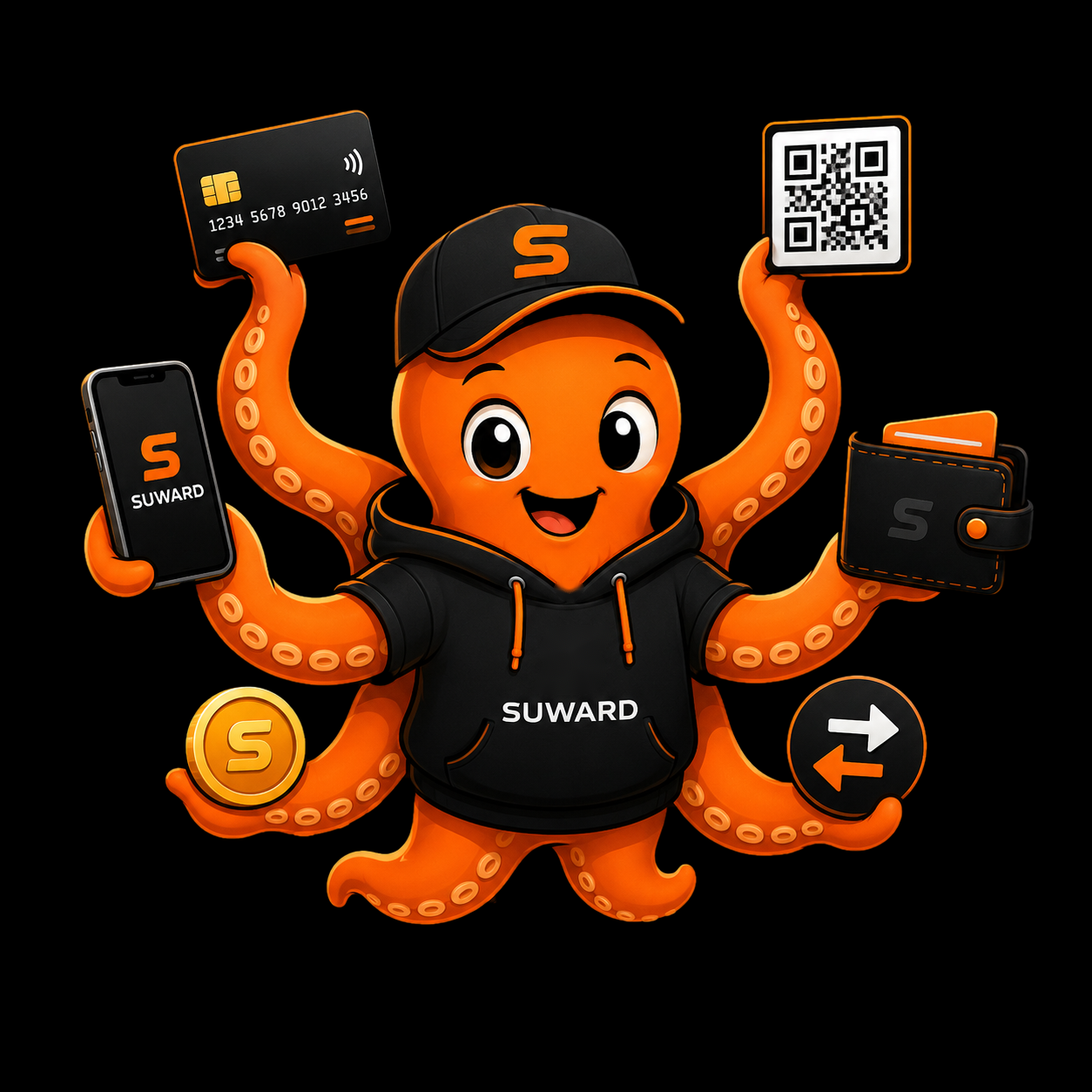
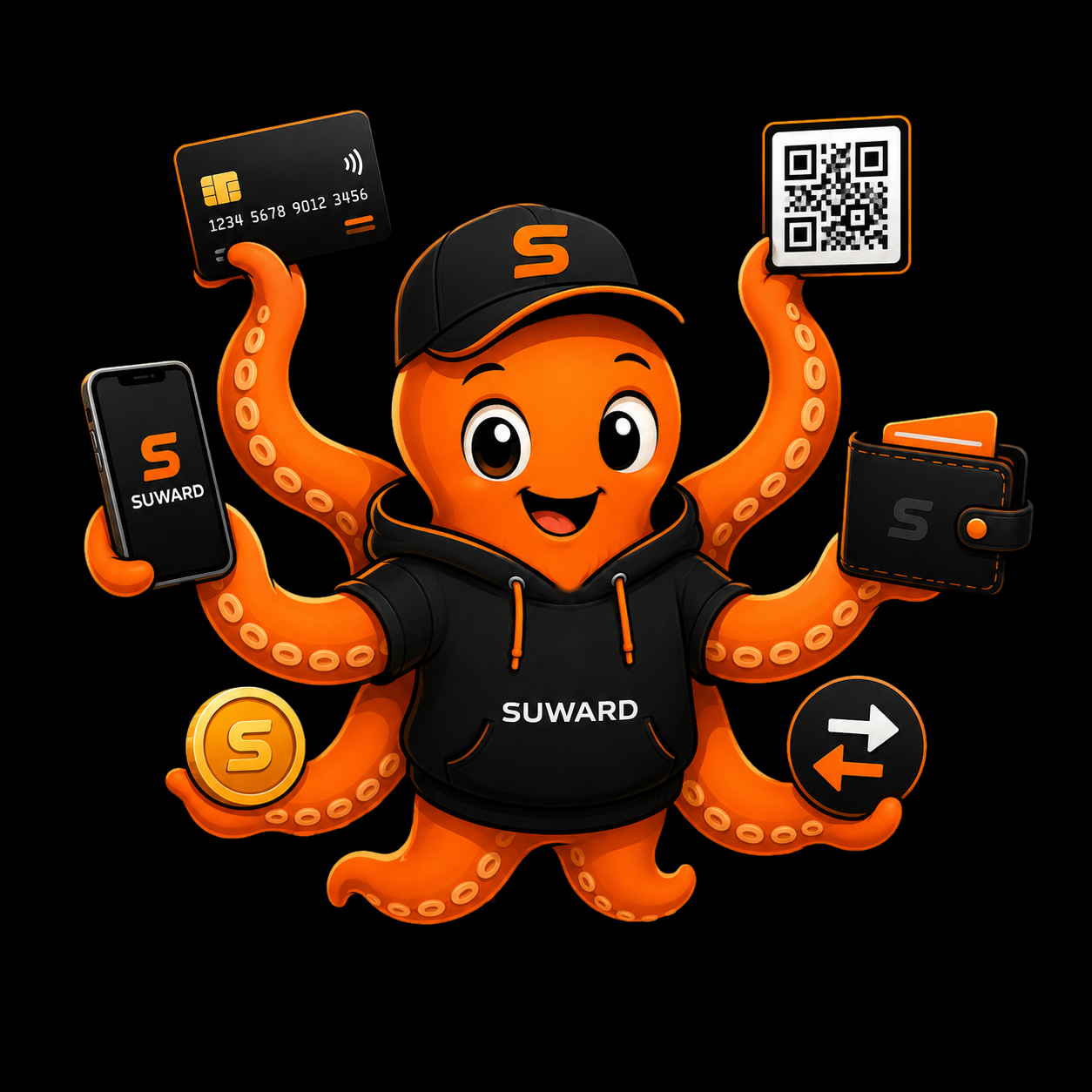
Suward is our brand and our helper. We pictured the gateway not as a faceless server but as a friendly eight-armed octopus, because a payment really is eight jobs happening at once. One arm forges a fresh deposit address. Others watch the chains, hold the funds, count confirmations, keep the ledger, and serve the hosted checkout. He isn't stern, and he isn't a mascot for the sake of being cute. He's an expert at work: calm and warm, and squarely on your side.
Su- (sure / secure) + -ward (guard / steward / warden) → the one who reliably guides a payment all the way to finality.
Every payment starts the same way. A merchant raises an invoice, and one of Suward's arms hands over a unique address-key, a separate deposit address used for that payment and no other. An ordinary service tends to do the steps in sequence. Suward runs them in parallel: his other arms hold the funds, watch the network, count confirmations, keep the balance, and build the hosted checkout with its QR code.
His grip holds to finality. A payment lands in Suward's arm and the suckers close around it. They hold through every confirmation, and they hold even when the network tries to rewrite recent history in a reorg. The arm opens at one moment only, when the configured finality threshold is met. That is the line between Safe and Finalized.
Clarity in the noise of the blockchain. Suward glows ember-orange against the dark, where pending transactions and competing forks blur into static and a reorg can rewrite what looked settled. His eight arms work in parallel and never drop a payment. Where another service ends up with a tangle, Suward keeps order.
Every job of a payment at once, across chains. Each arm holds its own payment object, so many arms mean many networks and many payments running side by side. Suward reaches across 7 EVM networks and 22 assets without putting them in a queue.
The hold that survives a reorg. Once the suckers close on a payment, they don't let go through confirmations or through a chain reorganization. The grip is what turns Pending into Safe, and then into Finalized.
A unique deposit address per payment. One arm holds the key out in front: a fresh address minted for each invoice, so two payments are never confused for one.
The money, and the fee. A measured touch of gold in one arm marks the value moment: the funds that landed, and the 0.4% + min $1 Suward keeps for the work.
Eight hands on every payment. Held to finality.
Most merchants are wary of accepting crypto, and the reasons are concrete: underpayments, reorgs that un-confirm a "settled" transfer, hidden spreads, outright scams. Suward answers each one with infrastructure rather than promises. A unique address per payment. Live network monitoring. Finality you can verify. Balances stored as Decimal128 that stay atomic and never go negative. A fee of 0.4% + min $1 with no markup buried in the rate. Honesty is part of the build, not a slogan: only what the code actually does ships to this site, and anything still in progress is labelled "Soon" rather than dressed up as done. Webhooks, analytics, auto-payout and SSE are on the roadmap and marked that way. No inflated metrics. No fake clients.
A payment is final when we say it's final, not a moment before. It moves through Pending → Safe → Finalized and holds through reorgs, then settles into balances that don't lie.
The fee is 0.4% + min $1, with no spread hidden in the exchange rate. Roadmap features wear a "Soon" label. The numbers on this page are real ones.
One REST API, a hosted checkout, a public sandbox, and idempotency keys so a retried request never double-charges. We'd rather ship code than banners.
Legal entity
CryLabs Org
We'd rather state service expectations plainly than print an uptime figure we can't yet stand behind. Our live status page shows the real picture.